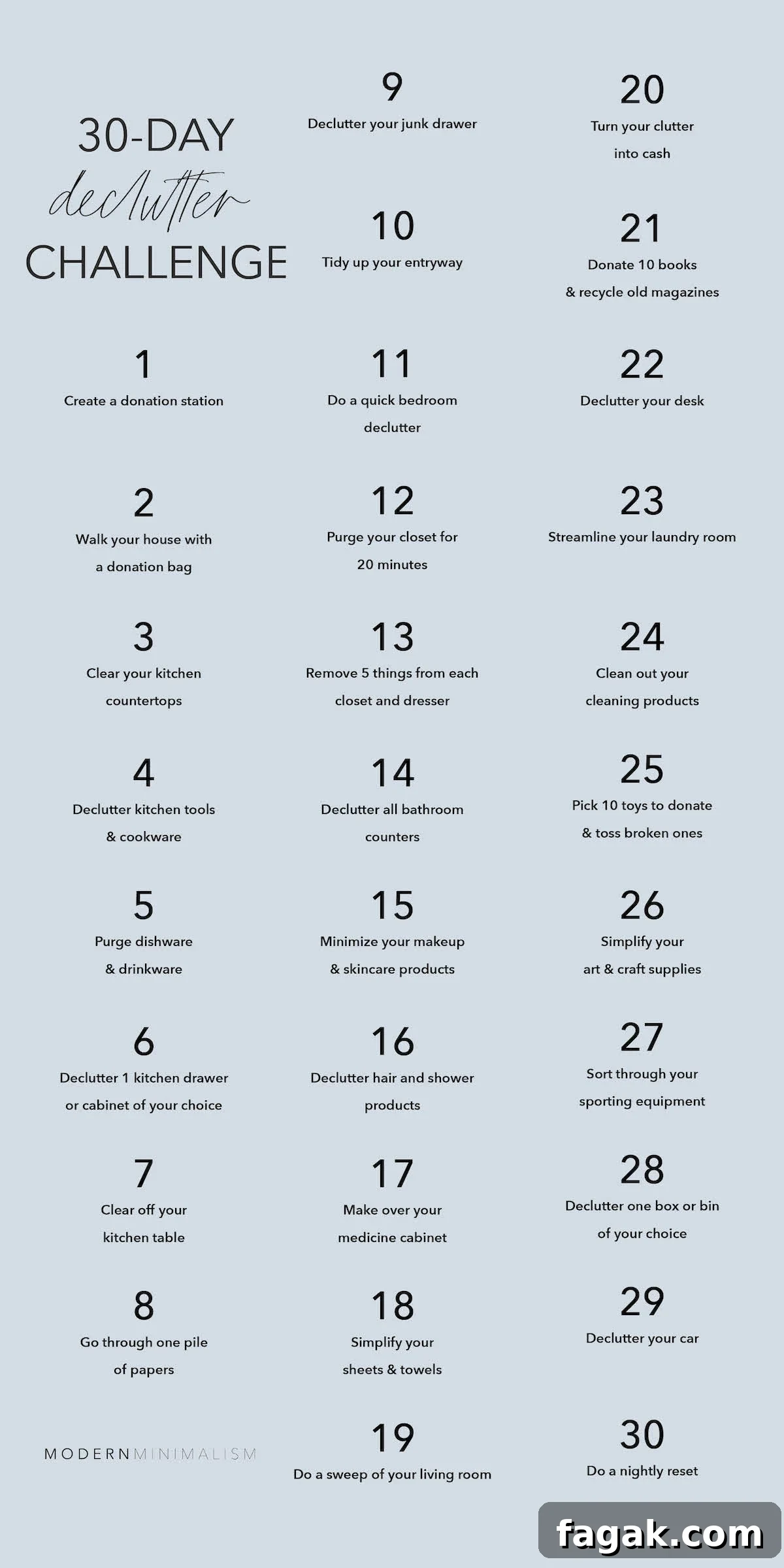
Want to declutter but unsure where to begin? Try this simple 30-Day Declutter Challenge—30 focused tasks you can complete in 20 minutes or less.
Over the next month, these short, manageable assignments will help you reduce clutter, create more space, and simplify daily routines. By the end of the challenge you’ll have a clearer sense of what adds value to your life and feel more comfortable letting go of items that don’t.
If you’d like to track your progress, sign up for a printable 30-Day Declutter Challenge calendar using the form below.
How this declutter challenge works
The challenge is straightforward: pick one task per day for 30 days. Doing the assignments in order is helpful, but you can jump around after the first task if needed. Assignment #1 takes only a few minutes but sets the tone, so try to complete it first.
Set a 20-minute timer for each task. Short time limits keep sessions manageable and prevent decluttering from turning into an all-day chore. These bitesized tasks build momentum, help you stay focused, and encourage quicker decisions.
Here are a few key topics covered in the challenge:
- Why decluttering matters
- How often to declutter
- Helpful questions to ask during the decluttering process
Why decluttering is important
Decluttering your home offers many benefits. A few notable ones are:
- Lower stress levels. Cluttered spaces can increase stress. Reducing clutter often leads to a calmer environment and lower stress both at home and beyond.
- Less time wasted searching for things. A clearer home makes it easier to find what you need and reduces the chance of repurchasing items you already own.
- Better focus and a greater sense of control. Visual clutter can be distracting. Simplifying your surroundings supports concentration and calm.
- Improved relationships. Decluttering can reduce household friction and make you more comfortable sharing your space with others.
- Greater functionality and easier maintenance. An uncluttered kitchen and living area make everyday tasks and cleaning simpler and faster.
How often should you declutter?
Ideally, declutter at least every few months. For many people, brief weekly or daily tidying prevents clutter from becoming overwhelming. Frequent small efforts are more sustainable and less daunting than infrequent, large purge sessions.
Questions to ask yourself when decluttering
When you’re unsure whether to keep an item, these quick questions can help you decide:
- Do I love it?
- Do I use it? When was the last time I used it?
- Do I need this item?
- Do I own a duplicate or something very similar?
- Will I want or need this in the future?
- Does something else already serve the same purpose?
- Does it work? If not, will I realistically repair it?
- Would I buy this again?
- Am I keeping this out of guilt?
- Could I easily borrow this when needed?
- Did I even remember I had this?
- Would I miss it if it were gone?
- Is it worth the time, space, money, and energy to keep it?
- Does it fit my current lifestyle?
- In what situation would I need this?
- Will I repair this within a week, or should I pass it on to someone who will?
30-Day Declutter Challenge Assignments
Below are the 30 daily assignments. Each task is designed to be completed in about 20 minutes.
1. Create a donation station.
Choose a large box or basket and a dedicated spot—garage, closet, or basement—to temporarily store items you plan to donate, sell, or recycle. When it fills up, remove the contents and return the empty container to its place.
2. Walk your house with a donation bag.
Carry a bag and collect items you no longer need, use, or love. Add them to your donation station.
3. Clear your kitchen countertops.
Remove decorative items, put away small appliances you don’t use daily, and wipe surfaces clean. Keep only essentials on view.
4. Declutter your kitchen tools and cookware.
Donate duplicates and single-use gadgets you don’t use. Toss broken or rusted items and store frequently used tools where they’re most convenient.
5. Purge dishware and drinkware.
Keep just enough plates, bowls, mugs, and glasses for daily use. Store extras out of the way for larger gatherings.
6. Declutter one kitchen drawer or cabinet.
Empty it, clean it, and return only what belongs and gets regular use.
7. Clear off your kitchen table.
Remove everything, wipe the surface, and return only items used during meals.
8. Go through one pile of papers.
Open mail, sort action items to handle this week, file or scan important documents, and recycle junk mail. Consider unsubscribing from catalogs you don’t want.
9. Declutter your junk drawer.
Decide what the drawer should contain, discard unnecessary items, and give each remaining item a purpose or new home.
10. Tidy up your entryway.
Limit coats and shoes to a few per person, return other items to closets, and use baskets for frequently used accessories.
11. Quick bedroom declutter.
Put away clothes, remove decor you don’t love, and clear bedside surfaces of nonessential items.
12. Purge your closet for 20 minutes.
Set a timer and remove stained, ill-fitting, or unused clothes that don’t match your lifestyle.
13. Remove five items from each closet and dresser.
Collect things to donate—mismatched socks, outgrown shoes, or unused clothing—and remove them from each bedroom.
14. Declutter bathroom counters.
Keep daily essentials contained in a small tray and store the rest in drawers or cabinets to make countertops easier to clean.
15. Minimize makeup and skincare.
Discard expired or rarely used products, clean brushes, and return only the items you use regularly.
16. Declutter hair and shower products.
Remove duplicates and products you don’t use, and keep extras in a cabinet to be used later.
17. Make over your medicine cabinet.
Remove everything, discard expired items, consolidate duplicates, and group similar supplies in a single container.
18. Simplify sheets and towels.
Keep two sets of sheets per bed and two towels per person; donate or repurpose the rest.
19. Sweep the living room.
Remove non-sentimental decor, excess throw blankets and pillows, and recycle old magazines. Keep only items you love and use.
20. Turn clutter into cash.
Identify items you can sell—furniture, decor, or appliances—clean them up, photograph them, and create clear listings to sell locally.
21. Declutter books and magazines.
Donate books you’ve read or won’t read and recycle magazines. Tear out and keep only the pages you truly want to save.
22. Declutter your desk.
Clear the surface, return only essential work items, and store backups out of sight. Recycle or shred old papers.
23. Streamline the laundry room.
Clear flat surfaces, return misplaced items to their homes, consolidate laundry products, and toss unmatched socks and extra hangers.
24. Organize cleaning supplies.
Gather supplies, consolidate duplicates, discard unusable items, and store them in a tub for easy access when cleaning.
25. Donate 10 toys and toss broken ones.
Select duplicates or outgrown toys to donate and discard anything broken. If you don’t have toys, pick a drawer or cabinet to declutter.
26. Simplify art and craft supplies.
Keep only what you use, discard dried-up supplies, recycle small scraps, and group items into containers for easy access.
27. Sort sporting equipment.
Declutter items that are outgrown, unused, or damaged. Donate or sell what you can and recycle or repurpose the rest.
28. Declutter one box or bin.
Pick a storage box—holiday decor, memorabilia, or forgotten items—and spend 20 minutes removing what no longer serves you.
29. Declutter your car.
Remove trash and personal items that don’t belong in the vehicle. Wipe down surfaces and keep a small routine to prevent future buildup.
30. Do a nightly reset.
Spend 20 minutes each evening resetting your space: wipe counters, load the dishwasher, prep coffee, set out clothes, and tidy common areas. A quick nightly reset makes mornings much easier.
Other decluttering articles you might like
- Try a 30-Day Minimalism Challenge to simplify home routines and mental load.
- If toys feel overwhelming, try a short toy declutter challenge to create order quickly.
- Use a simple, step-by-step approach to declutter your kitchen efficiently.
- Find streamlined methods for decluttering kids’ items like toys and books.
Pin this Challenge
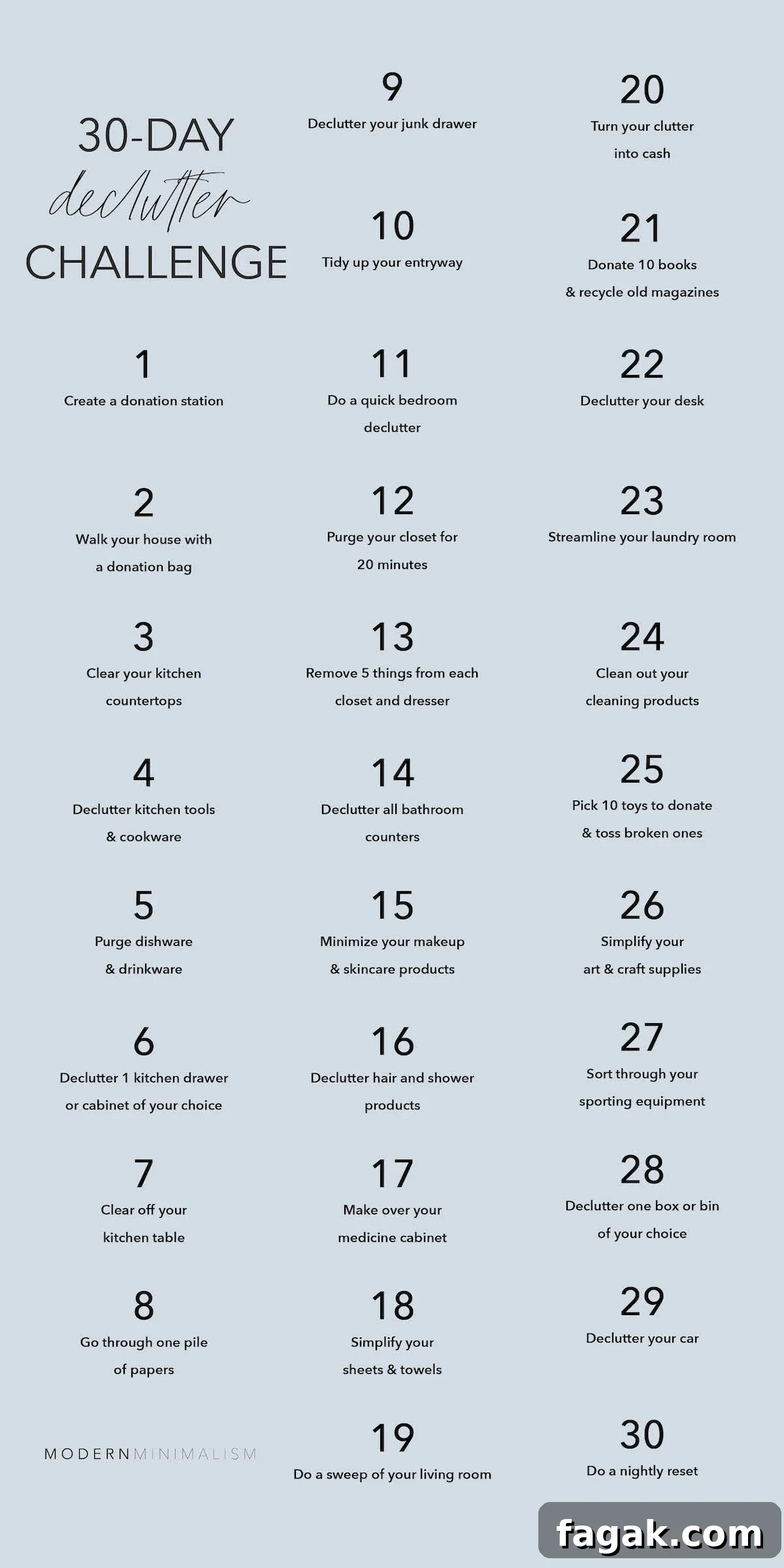
Table of Contents
Toggle