Are your kids tired of the same old “I’m bored” refrains? To offer a fresh solution to the screen-time struggle, I turned to the past. I spent an afternoon exploring a 1909 manual of games to collect activities that require no batteries, Wi‑Fi, or trips to the store.
These rediscovered Victorian games are lively, surprisingly addictive, and easy to adapt for modern families. Below are updated, screen-free versions of five favorites that bring a little analog fun back into the house.
1. The Spelling Game: The “No‑WiFi Wordle” Challenge
Originally called The Spelling Game in the 1909 manual, this parlor staple tests quick thinking and vocabulary. It works perfectly as a competitive, screen-free alternative to mobile word games and requires no equipment—making it an ideal anywhere boredom buster.
Best for Ages: 9 to Adults Players: 2 or more
How to Play:
- The Goal: Add a letter to a growing word fragment without being the person who finishes a valid word.
- The Start: The first player announces any letter (for example, “P”).
- The Build: Each player, in turn, adds one letter while keeping a real word in mind. For example, with the letters “P‑L‑A,” the next player might add “Y” thinking of playground or players, but must avoid completing a shorter valid word like play.
- The Challenge: If someone suspects another player of inventing letters, they can issue a challenge. The challenged player must name a real word they were trying to form; if they cannot, they lose a life. If they can, the challenger loses a life.
- Three Strikes: Players typically have three lives. Finishing a word or losing a challenge costs a life. The last player remaining wins.
Vintage Pro‑Tip: To increase difficulty for teens or adults, use the original rule that only words of four letters or more count as finished. That pushes players into longer, trickier vocabulary choices.
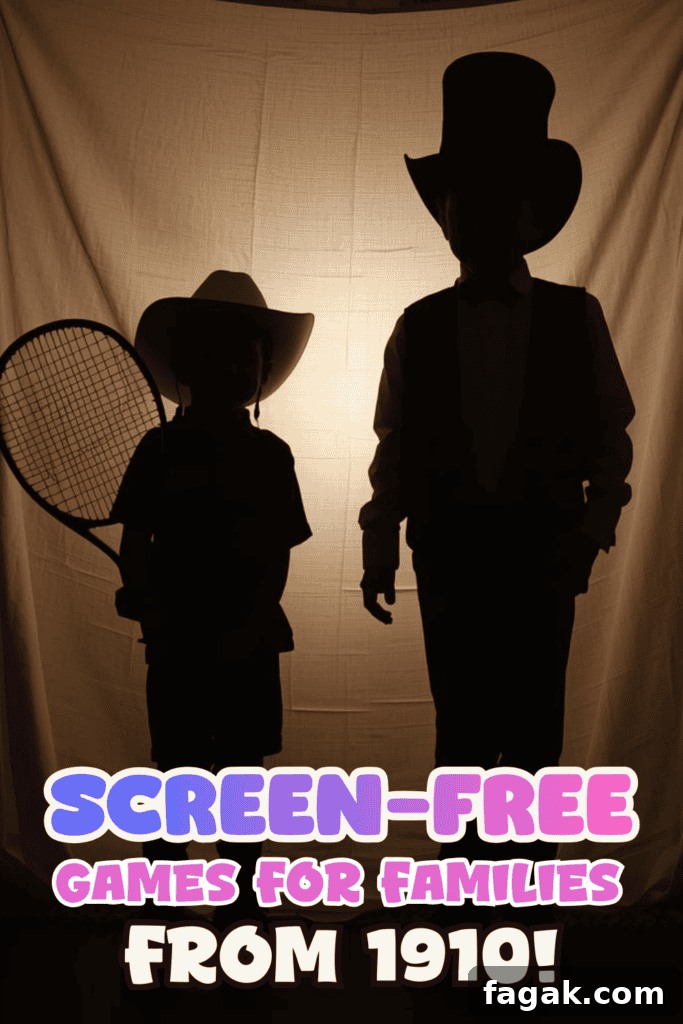
2. Shadow Buff: The 1909 Flashlight Challenge
Listed in the original manual, Shadow Buff was Victorian shadow play and easily becomes a memorable flashlight party or sleepover activity. It encourages observation and creativity instead of screen staring.
Best for Ages: 8–14 Players: 4 or more
How to Play:
- The Setup: Hang a white sheet or tablecloth across a doorway or section of the room. Place a single bright light—a flashlight or desk lamp—on a table about five feet behind the sheet.
- The Seeker: One player sits on a low stool in front of the sheet with all other lights off so only the lit fabric is visible.
- The Parade: Players pass one at a time between the light and sheet, casting a distinct silhouette.
- The Disguise: To make guessing harder, players alter their shadows by rumpling hair, wearing a hat, or changing posture.
- The Identification: The Seeker must identify who passed based only on the shadow. A correct guess makes that person the next Seeker.
Modern Pro‑Tip: Add a prop box with items that create unmistakable silhouettes—rackets, umbrellas, or funky hats—to make the game more entertaining and easier for younger players to join.
3. The Minister’s Cat: The 1909 Vocabulary Challenge
A classic circle game from the manual, The Minister’s Cat emphasizes rhythm, vocabulary, and quick thinking. It’s perfect for car rides, waiting rooms, or any moment you want to keep hands-free and screens away.
Best for Ages: 7 to Adults Players: 3 or more
How to Play:
- The Rhythm: Maintain a steady snap‑clap or slap‑clap beat. Staying on rhythm is essential.
- The Alphabet: The first player describes the cat with an adjective starting with A (for example, “The Minister’s cat is an A‑mbitious cat”).
- The Circle: The next player adds another adjective beginning with A, and so on around the circle.
- Moving On: After everyone contributes an A word, move to B, then C, progressing through the alphabet.
- The Knock‑Out: Hesitating, breaking rhythm, or repeating a word eliminates a player for that round.
Modern Pro‑Tip: Use a 30‑second limit for each turn as in the original rules. If a player can’t think of a word in that time, assign a simple forfeit like five jumping jacks to keep the pace lively.
4. The Little Dutch Band: The 1909 “Copycat” Challenge
Found in the 1909 book, The Little Dutch Band is energetic and chaotic—an early reaction game that builds focus, timing, and coordination.
Best for Ages: 5–12 Players: 4 or more
How to Play:
- Assign Instruments: Give each player an imaginary instrument—flute, drum, violin, etc.
- The Performance: The leader starts a lively air‑band performance. Everyone mimics playing their assigned instrument.
- The Switch: The leader suddenly drops their instrument and pretends to play someone else’s instrument.
- The Reaction: When the leader takes over your instrument, you must instantly switch to the leader’s instrument.
- The Chaos: As the leader rapidly switches, the band swaps assignments. Players who don’t react quickly are out of the round.
Modern Pro‑Tip: Use a fast pop song to keep the energy high and make this a great indoor energy‑buster on rainy days.
5. Thought Reading: The “Secret Signal” Mystery
This trick from the 1909 manual is a simple “thought reading” illusion kids can perform to amaze friends or family. It encourages cooperation between two partners and makes an engaging screen‑free activity.
Best for Ages: 8–14 Players: 3 or more (requires two partners)
How to Play:
- The Partners: Two players agree to be the Thought Readers. One steps out of the room while the other stays with the audience.
- The Selection: The audience secretly chooses an object in the room, such as a pillow.
- The Recall: The partner outside is called back in. The partner inside points to various objects asking, “Is it this?”
- The Secret: The classic signal is that the correct object is always pointed to immediately after the pointer indicates an object with four legs—like a chair or table.
- The Reveal: The pointer points to the correct item directly after a four‑legged object, allowing the partner to “read minds” and astound the audience.
Modern Pro‑Tip: Once kids master the four‑legged signal, encourage them to invent new codes—such as the correct object follows one that is red—to turn the trick into a creative logic puzzle.
Why Vintage Games Work So Well
The charm of these 1909 classics is that they require little to no preparation and rely on imagination and social interaction. They don’t need new gear, apps, or instructional videos—just people willing to play. Introducing these simple activities gives kids a break from screens while sharpening creativity, memory, and social skills.
Below the image is a simple scene that captures the spirit of these games—kids silhouetted behind a sheet, ready to play and invent new variations.